

Before we dive deep into our topic about how to fix Windows Hello PIN Setup Errors in Windows 11 and Windows 10, imagine sitting down to use your computer, entering the settings to create a PIN, and being greeted by an error message instead of a successful confirmation. It can be frustrating, especially when you need quick access to your device for work, school, or personal tasks.
Many Windows users experience this issue, and while it may seem serious, it is often caused by a few common system or configuration problems that can be fixed without reinstalling Windows.
The Windows Hello PIN Setup process is designed to provide a secure and convenient alternative to traditional passwords. Instead of typing a long password every time you sign in, Windows Hello allows you to use a PIN, fingerprint, or facial recognition. A PIN is device-specific, meaning even if someone learns your Microsoft account password, they still cannot use your PIN on another computer.
However, the Windows Hello PIN setup process sometimes fails to complete. You might receive messages such as:
- Something went wrong.
- We couldn’t set up your PIN.
- This option is currently unavailable.
- Number Error 0x80090011
- Error 0x8009002D
- Code Error 0x801C03
- Error 0x80070490
These errors may look different, but they often have similar causes. Corrupted system files, TPM issues, outdated Windows components, damaged PIN configuration files, or Microsoft account synchronization problems can all interrupt the setup process.
This comprehensive guide explains the major causes of PIN setup failures and provides practical, step-by-step solutions suitable for both beginners and experienced users. By the end of this guide, you’ll understand not only how to fix the problem but also how to prevent it from happening again.
Understanding Windows Hello PIN Setup
Before troubleshooting, it’s important to understand what Windows Hello actually does.
Windows Hello is Microsoft’s biometric and PIN-based authentication platform. It replaces passwords with authentication methods that are faster, easier, and generally more secure.
Authentication options include:
- PIN
- Fingerprint
- Facial Recognition
- Security Key
Unlike traditional passwords, the PIN created during Windows Hello PIN Setup is stored securely on your device. It is protected using encryption and usually works together with the Trusted Platform Module (TPM), a hardware security chip found in most modern computers.
Example
Suppose you use the same Microsoft account on your desktop, laptop, and tablet.
Your password works across every device.
However, if your laptop PIN is 483920, that PIN only unlocks your laptop. It cannot be used to access your desktop or Microsoft account online.
This device-specific design significantly improves security.
Why Does Windows Hello PIN Setup Fail?
There isn’t a single reason behind PIN setup failures. Windows relies on multiple services, security components, and account settings working together.
Some common causes include:
- Corrupted NGC folder
- Damaged Windows system files
- Microsoft account verification issues
- Disabled TPM
- Outdated Windows updates
- Incorrect date and time
- Group Policy restrictions
- Registry misconfigurations
- Enterprise security policies
- Antivirus interference
- BIOS changes
- Hardware security problems
The good news is that most of these issues are fixable without losing your files.
Signs That Your PIN Configuration Is Corrupted
If your computer exhibits any of the following symptoms, there’s a good chance the PIN configuration has become corrupted:
- PIN option disappears
- “Add PIN” button doesn’t respond
- PIN removal fails
- Error appears immediately during setup
- Windows asks for your password repeatedly
- PIN works after restart but later fails
- Fingerprint sign-in also stops working
These symptoms often indicate damaged authentication files rather than hardware failure.
1: Restart Your Computer to Fix Windows Hello PIN Setup
This may sound too simple, but restarting Windows resolves countless authentication issues.
Many Windows services restart during boot, including:
- Credential Manager
- Windows Biometric Service
- Microsoft Account Sign-In Assistant
Example
Imagine your computer automatically installed updates overnight.
Although installation completed successfully, authentication services were never restarted.
A simple reboot refreshes every security service.
Always try this first before moving to advanced troubleshooting.
2: Check Windows Updates
Older Windows builds occasionally contain bugs affecting authentication.
Open:
Settings → Windows Update
Click:
Check for Updates
Install:
- Security Updates
- Feature Updates
- Optional Driver Updates
Restart your computer afterward.
Real-Life Example
A Windows 11 cumulative update once resolved several PIN-related authentication bugs that prevented users from creating new credentials after upgrading from Windows 10.
Keeping Windows up to date often fixes these hidden issues automatically.
3: Verify Your Microsoft Account
Sometimes Windows cannot verify your account credentials.
Navigate to:
Settings → Accounts → Your Info
If Windows requests verification, complete the process.
Verification usually involves:
- Email confirmation
- SMS verification
- Microsoft Authenticator approval
If identity verification fails, Windows Hello PIN Setup cannot proceed.
Example
Suppose you recently changed your Microsoft password using another device.
Until Windows synchronizes those new credentials, PIN creation may continue failing.
Simply signing out and back into your Microsoft account often resolves the synchronization issue.
4: Check Your Internet Connection
Although Windows Hello itself works offline after setup, creating a PIN for a Microsoft account often requires internet access.
A weak or unstable network may interrupt authentication.
Things to try include:
- Restart your router.
- Connect to another Wi-Fi network.
- Use an Ethernet cable if available.
- Disable VPN software temporarily.
Example
A hotel Wi-Fi network that blocks Microsoft authentication servers may prevent PIN creation even though websites load normally.
Switching to a mobile hotspot often resolves the issue immediately.
5: Remove the Existing PIN
If you’re replacing an existing PIN, removing it first can solve many problems.
Go to:
Settings → Accounts → Sign-in Options
Select:
PIN (Windows Hello)
Click:
Remove
Restart Windows.
Then create a brand-new PIN.
Corrupted PIN records are among the most common reasons Windows Hello PIN Setup fails to complete.
6: Delete the NGC Folder
The NGC folder stores PIN-related information.
If these files become damaged, Windows cannot generate new PIN credentials.
The folder is located here:
C:\Windows\ServiceProfiles\LocalService\AppData\Local\Microsoft\NGC
You may need administrator permission to access it.
Steps
- Take ownership of the folder.
- Delete every file inside.
- Restart Windows.
- Try creating your PIN again.
Why This Works
Deleting the folder forces Windows to create fresh authentication data.
Think of it as resetting the PIN database without affecting your personal documents.
Many users successfully complete Windows Hello PIN Setup immediately after rebuilding the NGC folder.
7: Enable TPM
TPM stands for Trusted Platform Module.
This small security chip stores encryption keys required by Windows Hello.
Without TPM, Windows may refuse to create secure authentication credentials.
Check TPM Status
Press:
Windows + R
Type:
tpm.msc
If Windows reports that TPM is unavailable or disabled, you’ll likely need to enable it in BIOS or UEFI settings.
Example
A BIOS update can sometimes disable TPM by resetting firmware settings to their defaults. After re-enabling TPM and saving the changes, Windows Hello often starts working again.
8: Make Sure Secure Boot Is Enabled
Secure Boot works with TPM to protect the operating system during startup. If it has been disabled—perhaps after installing another operating system or changing BIOS settings—it can interfere with security features.
To check:
- Restart your PC and enter the BIOS/UEFI.
- Locate the Secure Boot option.
- Ensure it is enabled.
- Save the changes and restart Windows.
While Secure Boot is not always the direct cause, enabling it helps maintain a trusted environment for Windows Hello PIN Setup.
9: Run the System File Checker (SFC)
Windows includes a built-in tool called System File Checker that scans for damaged or missing operating system files.
Open Command Prompt as Administrator and run:
sfc /scannow
The scan may take 10–30 minutes depending on your system.
Example
If a power outage interrupted a Windows update, some authentication-related files might be corrupted. SFC replaces these files automatically using cached copies, often resolving PIN setup issues without additional repairs.
10: Repair Windows Using DISM
If SFC reports that it couldn’t fix all issues, the next step is to repair the Windows image itself.
Run the following command in an elevated Command Prompt:
DISM /Online /Cleanup-Image /RestoreHealth
DISM checks the integrity of the Windows image and downloads clean components if necessary.
After it completes:
- Restart the computer.
- Run
sfc /scannowagain. - Attempt the PIN setup.
This combination repairs many deep system issues that interfere with Windows Hello PIN Setup.
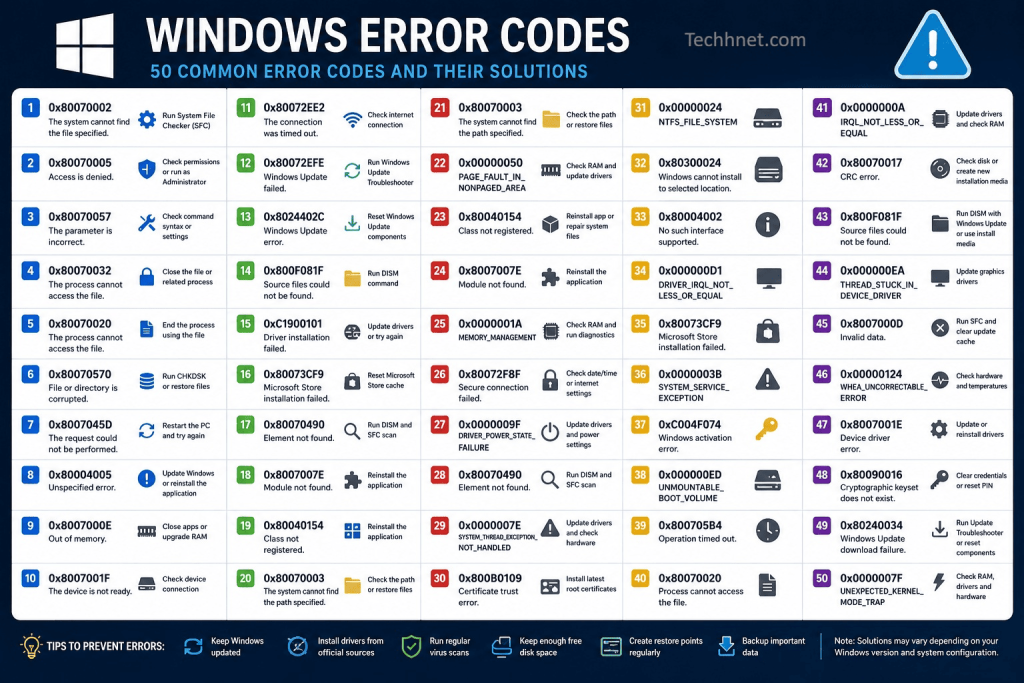
Common Error Codes and Their Meaning
| Error Code | Possible Cause | Recommended Fix |
|---|---|---|
| 0x80090011 | TPM issue | Enable or reset TPM |
| 0x8009002D | Corrupted PIN files | Delete NGC folder |
| 0x801C03 | Microsoft account synchronization | Verify account and reconnect |
| 0x80070490 | Missing system components | Run SFC and DISM |
| 0x801C044D | Device registration problem | Reconnect work or school account |
Understanding the error code can save time by pointing you toward the most likely solution instead of trying every fix at random.
Why These Problems Are More Common After Windows Updates
Many users notice PIN issues immediately after installing a feature update. This happens because major updates replace system files, update security components, and sometimes reset firmware-related settings.
For example, a feature update may:
- Reinitialize authentication services.
- Require TPM firmware communication.
- Rebuild user profile security data.
- Update device drivers.
- Change sign-in policies.
If any of these steps are interrupted or an error occurs, PIN creation can fail until the underlying issue is resolved.
Advanced Troubleshooting Methods to Fix Windows Hello PIN Setup Errors
If the basic troubleshooting methods didn’t resolve the issue, don’t worry. PIN setup problems are sometimes caused by deeper system-level issues involving Windows services, security policies, user profiles, or firmware settings. This section focuses on advanced solutions that can resolve even persistent authentication errors.
While some of these methods require administrator access, none of them should affect your personal files when performed correctly.
11: Reset Windows Hello Credentials
Over time, Windows Hello credentials can become corrupted due to interrupted updates, failed synchronization, or software conflicts. Resetting these credentials forces Windows to create a completely new authentication profile.
To do this:
- Open Settings.
- Navigate to Accounts > Sign-in options.
- Remove your existing PIN if possible.
- Remove any registered fingerprint or facial recognition data.
- Restart your computer.
- Create a new PIN.
If the old authentication data was damaged, resetting everything often allows Windows Hello PIN Setup to complete successfully.
Example
Imagine your laptop loses power while Windows is updating security components. After restarting, your fingerprint reader no longer works, and adding a PIN generates an error. Removing all Windows Hello credentials and setting them up again rebuilds the authentication database and often resolves the issue.
12: Create a New User Profile
Sometimes the problem isn’t Windows itself—it is your user profile.
A Windows profile contains personal settings, permissions, and authentication information. If the profile becomes corrupted, PIN creation may fail regardless of how many troubleshooting steps you try.
Create a New Account
- Open Settings.
- Select Accounts.
- Choose Other users.
- Click Add account.
- Create a new local or Microsoft account.
- Sign into the new account.
Now attempt to configure a PIN.
Example
Suppose two people share the same computer.
- User A cannot create a PIN.
- User B creates one without any issues.
This strongly suggests that User A’s profile is corrupted rather than Windows itself.
If the new account works properly, consider moving your files to the new profile instead of reinstalling Windows.
13: Check Windows Services
Windows Hello depends on several background services.
If one of these services is disabled, authentication can fail.
Press Windows + R, type:
services.msc
Verify these services are running:
- Microsoft Account Sign-in Assistant
- Credential Manager
- Windows Biometric Service
- User Manager
- Remote Procedure Call (RPC)
If any required service is stopped:
- Double-click it.
- Set Startup Type to Automatic.
- Click Start.
Restart the computer afterward.
14: Perform a Clean Boot
Many users install third-party software that interacts with Windows security.
Examples include:
- VPN software
- Enterprise security agents
- Password managers
- Endpoint protection suites
- Identity management software
These applications sometimes interfere with Windows Hello PIN Setup.
A Clean Boot starts Windows with only essential Microsoft services.
Steps
- Press Windows + R.
- Type msconfig.
- Open the Services tab.
- Check Hide all Microsoft services.
- Disable remaining services.
- Restart Windows.
Now attempt to create your PIN.
Example
A corporate VPN client may install authentication drivers that conflict with Windows Hello. During a Clean Boot, those drivers remain inactive, allowing the PIN setup process to complete successfully.
15: Temporarily Disable Third-Party Antivirus
Although antivirus software improves security, some products monitor system authentication very closely.
Occasionally they block:
- Credential creation
- TPM communication
- Protected folders
- Identity verification
Temporarily disable your antivirus software and try creating a PIN again.
If this resolves the issue:
- Update the antivirus software.
- Add Windows security components to its exclusion list if supported.
- Contact the software vendor for compatibility guidance.
Remember to re-enable your antivirus immediately after testing.
16: Check Date, Time, and Region Settings
Incorrect system time is an overlooked cause of authentication failures.
Microsoft account verification relies on accurate timestamps.
Open:
Settings > Time & Language
Ensure:
- Date is correct.
- Time is correct.
- Time zone is correct.
- “Set time automatically” is enabled.
- “Set time zone automatically” is enabled.
Example
If your computer’s CMOS battery begins failing, the system clock may reset after every shutdown. Even if the difference is only a few minutes, authentication requests can fail during Windows Hello PIN Setup.
17: Use Event Viewer to Identify the Exact Error
When Windows encounters an authentication failure, it often records detailed information in Event Viewer.
Press Windows + R and type:
eventvwr.mscNavigate to:
- Applications and Services Logs
- Microsoft
- Windows
- HelloForBusiness
Review recent error entries.
You may discover messages indicating:
- TPM initialization failed.
- Certificate validation failed.
- User registration failed.
- Device registration timed out.
These logs provide valuable clues that generic error messages do not reveal.
18: Check Group Policy Settings
If you’re using Windows Pro, Enterprise, or Education editions, Group Policy settings may control Windows Hello functionality.
Open:
gpedit.mscNavigate to:
Computer Configuration > Administrative Templates > System > Logon
Review policies related to:
- Windows Hello for Business
- Convenience PIN Sign-in
- Biometrics
If your computer belongs to an organization, avoid changing these settings without permission.
Example
A company may disable personal PIN authentication because employees are required to use smart cards or security keys instead.
19: Inspect Registry Settings Carefully
The Windows Registry stores authentication-related configuration values.
Incorrect registry modifications made by optimization software or manual edits can prevent PIN creation.
Before making changes:
- Create a System Restore Point.
- Export the registry key you plan to modify.
Look under authentication-related keys only if you know what you are doing. Random registry edits can create additional problems.
For most home users, editing the registry should be considered only after trying safer troubleshooting methods.
20: Reset the Trusted Platform Module (TPM)
If TPM data becomes corrupted, Windows Hello may be unable to generate new security keys.
To reset TPM:
- Open Windows Security.
- Select Device Security.
- Open Security Processor Details.
- Choose Security Processor Troubleshooting.
- Select Clear TPM if appropriate.
Important: Before clearing TPM, ensure you have access to any required BitLocker recovery keys or other encryption credentials. Clearing TPM can affect encrypted drives and stored security keys.
Example
After replacing a motherboard battery or updating firmware, TPM metadata can occasionally become inconsistent. Resetting TPM allows Windows to generate new secure credentials during Windows Hello PIN Setup.
21: Review BIOS or UEFI Security Settings
Firmware settings directly affect Windows security features.
Open your BIOS or UEFI menu and verify:
- TPM is enabled.
- Secure Boot is enabled.
- Firmware is updated.
- Intel PTT or AMD fTPM is enabled (depending on your processor).
Modern Windows security features rely heavily on these firmware options.
22: Disconnect and Reconnect Work or School Accounts
Devices managed by schools or businesses often synchronize with Microsoft Entra ID (formerly Azure Active Directory).
If synchronization becomes corrupted:
- Open Settings.
- Go to Accounts > Access work or school.
- Disconnect the account.
- Restart the computer.
- Connect the account again.
This refreshes device registration and frequently resolves authentication issues.
23: Check for Driver Problems
Outdated drivers can interfere with security hardware.
Pay particular attention to:
- TPM drivers
- Chipset drivers
- Security device drivers
- BIOS firmware
- Storage controller drivers
Visit your computer manufacturer’s support page and install the latest recommended versions.
Example
A user installs Windows from scratch but keeps the generic chipset driver provided by Windows Update. After installing the manufacturer’s chipset package, TPM communication begins working normally and PIN creation succeeds.
24: Scan for Malware
Although relatively uncommon, malware can damage Windows authentication components.
Run:
- Microsoft Defender Offline Scan
- A full antivirus scan
- A second-opinion malware scanner if necessary
Removing malicious software may restore normal Windows security functionality.
25: Repair Windows Without Losing Personal Files
If every troubleshooting step fails, an in-place Windows repair installation is often the best solution before considering a full reset.
An in-place repair:
- Reinstalls Windows system files.
- Preserves applications.
- Keeps personal documents.
- Retains most settings.
Because authentication components are rebuilt during the repair, stubborn PIN-related problems are frequently resolved without requiring a clean installation.
Advanced Troubleshooting Checklist
Before moving to a complete Windows reset, verify the following:
| Check | Status |
|---|---|
| Windows fully updated | ✓ |
| Microsoft account verified | ✓ |
| Internet connection stable | ✓ |
| TPM enabled | ✓ |
| Secure Boot enabled | ✓ |
| NGC folder rebuilt | ✓ |
| SFC completed | ✓ |
| DISM completed | ✓ |
| User profile tested | ✓ |
| Event Viewer reviewed | ✓ |
| Drivers updated | ✓ |
| Antivirus tested | ✓ |
| Clean Boot performed | ✓ |
Working through this checklist methodically helps eliminate the most common causes of PIN setup failures and greatly increases the likelihood of successfully completing Windows Hello PIN Setup.
Why Patience Matters During Troubleshooting?
It is tempting to jump straight to reinstalling Windows when the PIN refuses to work, but that is rarely necessary. Most authentication issues stem from a single configuration problem rather than widespread operating system damage.
By testing one solution at a time and restarting your computer after major changes, you can identify the root cause rather than masking it with a full reinstall. This approach saves time, preserves your settings, and helps you understand how Windows security features work together.
By now, you’ve explored both basic and advanced troubleshooting methods. In most cases, one of the earlier solutions will resolve the issue. However, understanding how to prevent future problems is just as important as fixing the current one. This final section answers the most common questions users have, shares maintenance tips, and explains when it may be time to seek professional assistance.
Frequently Asked Questions About Windows Hello PIN Setup
1. Why does Windows keep asking me to create a PIN?
Windows encourages users to create a PIN because it offers a faster and more secure sign-in experience than a traditional password. If you skip the process during installation or after adding a Microsoft account, Windows may continue reminding you to complete Windows Hello PIN Setup.
In some cases, repeated prompts may also indicate that the previous PIN configuration was damaged or removed.
2. Is Windows Hello PIN safer than a password?
Yes, in many situations it is.
A traditional password can potentially be used on any device where your Microsoft account is accessible. A Windows Hello PIN, however, is tied to the specific device on which it was created. Even if someone learns your Microsoft account password, they cannot use your PIN to unlock another computer.
When combined with TPM and Secure Boot, the authentication process becomes significantly more resistant to common attacks.
3. Will deleting the NGC folder delete my personal files?
No.
The NGC folder only stores PIN-related authentication information. Removing it resets Windows Hello credentials but does not affect your:
- Documents
- Photos
- Videos
- Installed applications
- Desktop files
After deleting the folder, you’ll simply need to complete Windows Hello PIN Setup again.
4. Does Windows Hello require an internet connection?
Not always.
Creating or verifying a PIN for a Microsoft account may require internet access during the initial setup, especially if account verification is needed. Once the PIN has been created, you can usually sign in offline because the credential is stored securely on your device.
5. What should I do if none of the fixes work?
If you’ve completed every troubleshooting step and the issue still persists, consider these final options:
- Perform an in-place repair installation.
- Reset Windows while keeping your personal files.
- Contact your computer manufacturer’s support team if TPM or firmware problems are suspected.
- Reach out to Microsoft Support for account-related issues.
A complete clean installation should generally be the last resort.
When Should You Contact Professional Support?
Although most users can resolve PIN problems themselves, some situations require expert assistance.
Consider contacting support if:
- TPM is no longer detected in BIOS.
- The motherboard has recently been replaced.
- Windows repeatedly reports hardware security failures.
- Your device is managed by a workplace or school.
- You suspect hardware damage after a power surge or liquid spill.
Enterprise-managed devices may also have policies that intentionally prevent changes to authentication methods.
Expert Recommendations on Windows Hello PIN Setup Errors
Based on the most common support cases, here are a few practical recommendations:
- Start with the simplest fixes, such as restarting your computer and installing Windows updates.
- Use built-in repair tools like SFC and DISM before considering a system reset.
- Check TPM and Secure Boot if authentication errors continue after updates.
- Keep your Microsoft account information current to avoid synchronization problems.
- Create restore points before making advanced system changes.
- Document any error codes you receive, as they can make troubleshooting much faster.
Following these practices can reduce downtime and make future troubleshooting much easier.
Final Thoughts on How to Fix Windows Hello PIN Setup Errors
PIN setup failures can be frustrating, especially when they prevent you from accessing one of Windows’ most convenient security features. Fortunately, these problems are rarely caused by permanent hardware failure. In most situations, the issue is linked to corrupted authentication data, outdated system files, disabled security settings, or account synchronization errors.
By following the troubleshooting methods outlined throughout this guide—from checking Windows updates and rebuilding the NGC folder to verifying TPM settings and repairing system files—you can resolve the vast majority of PIN-related problems without reinstalling Windows or losing your personal data.
Remember that security features such as Windows Hello rely on several components working together, including your Microsoft account, Trusted Platform Module, Windows services, firmware settings, and system files. Taking a systematic approach to troubleshooting is far more effective than trying random fixes.
Once Windows Hello PIN Setup is functioning correctly, you’ll benefit from faster sign-ins, improved device security, and a more seamless Windows experience. Regular updates, proper maintenance, and careful management of your device’s security settings will help ensure that your PIN continues to work reliably for years to come.
Hi, this is a comment.
To get started with moderating, editing, and deleting comments, please visit the Comments screen in the dashboard.
Commenter avatars come from Gravatar.